<?xml version="1.0" encoding="utf-8"?><feed xmlns="http://www.w3.org/2005/Atom" ><generator uri="https://jekyllrb.com/" version="3.10.0">Jekyll</generator><link href="https://danielhk2004.github.io/MP/feed.xml" rel="self" type="application/atom+xml" /><link href="https://danielhk2004.github.io/MP/" rel="alternate" type="text/html" /><updated>2026-06-18T21:22:15+00:00</updated><id>https://danielhk2004.github.io/MP/feed.xml</id><title type="html">Physics and Mathematics</title><subtitle></subtitle><author><name>Daniel Hakimi</name></author><entry><title type="html">Analytical Study of Spin–Gravity Coupling in Plane Gravitational Wave Spacetimes</title><link href="https://danielhk2004.github.io/MP/quantum/gravity/Analytical-Study-of-Spin-Gravity-Coupling/" rel="alternate" type="text/html" title="Analytical Study of Spin–Gravity Coupling in Plane Gravitational Wave Spacetimes" /><published>2026-01-01T00:00:00+00:00</published><updated>2026-01-01T00:00:00+00:00</updated><id>https://danielhk2004.github.io/MP/quantum/gravity/Analytical-Study-of-Spin%E2%80%93Gravity-Coupling</id><content type="html" xml:base="https://danielhk2004.github.io/MP/quantum/gravity/Analytical-Study-of-Spin-Gravity-Coupling/"><![CDATA[<p style="color:#1e3a8a !important; font-weight:bold;">
Analytical Study of Spin–Gravity Coupling in Plane Gravitational Wave Spacetimes
</p>
<p align="center">
  <img src="/MP/assets/images/SGC.jpeg" width="750" />
</p>
<hr />
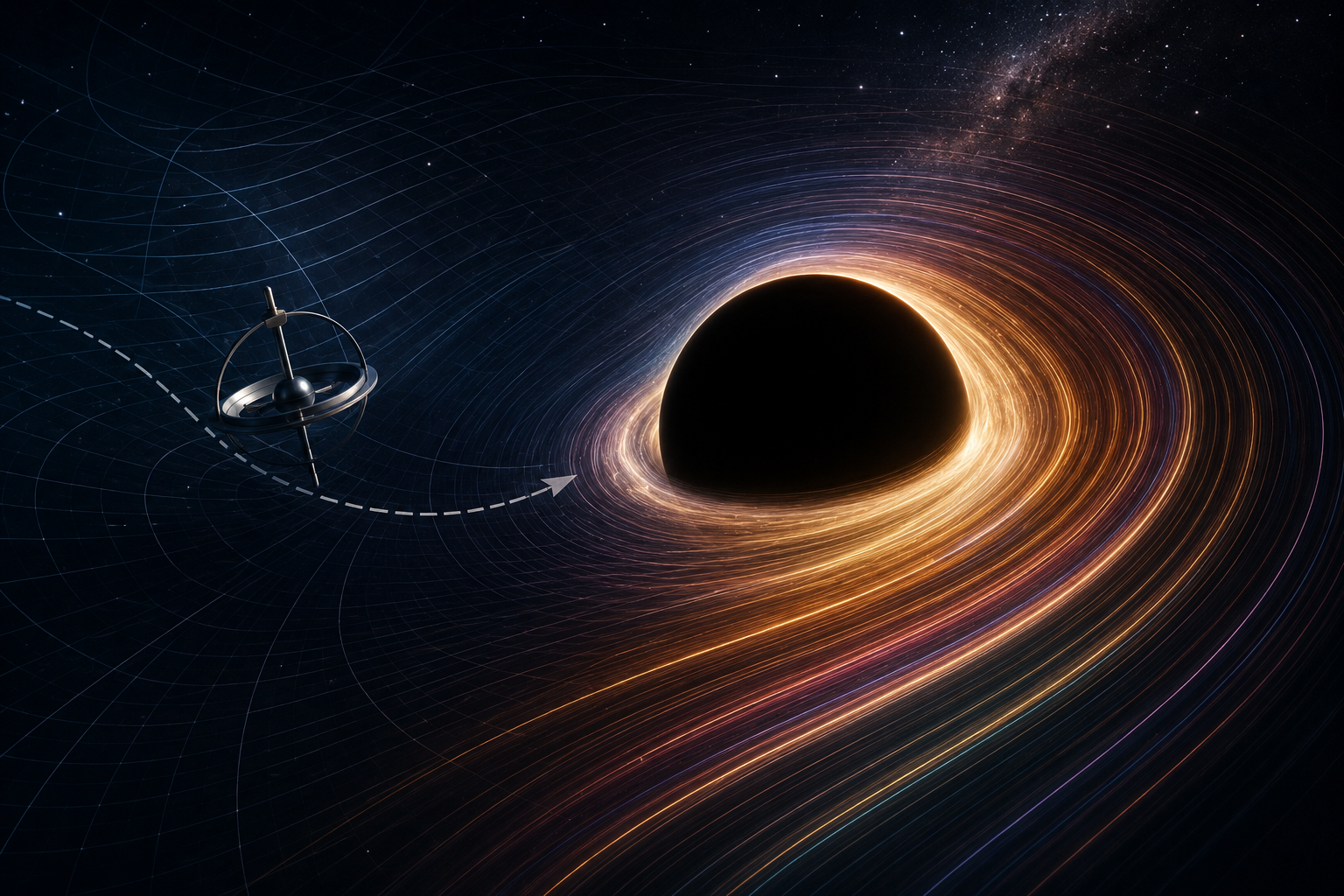
<p>In this note, using existing methods, we investigate spin-gravity coupling in a plane gravitational wave spacetime via the Mathisson–Papapetrou–Dixon (MPD) equations. Working in Rosen coordinates for their geometric simplicity, we examine the MPD equations to first order in spin. Our analysis shows how projecting the spin vector onto a parallel-transported orthonormal tetrad leads to conserved quantities, and how spin-curvature coupling gives rise to deviations from geodesic motion. The approach we follow does not rely on a specific wave profile or initial conditions, allowing for a general treatment of plane gravitational waves with arbitrary polarization.</p>

<p><a href="/MP/files/Analytical Study of Spin–Gravity Coupling.pdf">Analytical Study of Spin–Gravity Coupling in Plane Gravitational Wave Spacetimes</a></p>]]></content><author><name>Daniel Hakimi</name></author><category term="Quantum" /><category term="Gravity" /><category term="MPD equations" /><category term="Spin-Gravity Coupling" /><summary type="html"><![CDATA[Analytical Study of Spin–Gravity Coupling in Plane Gravitational Wave Spacetimes In this note, using existing methods, we investigate spin-gravity coupling in a plane gravitational wave spacetime via the Mathisson–Papapetrou–Dixon (MPD) equations. Working in Rosen coordinates for their geometric simplicity, we examine the MPD equations to first order in spin. Our analysis shows how projecting the spin vector onto a parallel-transported orthonormal tetrad leads to conserved quantities, and how spin-curvature coupling gives rise to deviations from geodesic motion. The approach we follow does not rely on a specific wave profile or initial conditions, allowing for a general treatment of plane gravitational waves with arbitrary polarization. Analytical Study of Spin–Gravity Coupling in Plane Gravitational Wave Spacetimes]]></summary></entry><entry><title type="html">Physical Inconsistency of the Corinaldesi–Papapetrou SSC in Schwarzschild Spacetime</title><link href="https://danielhk2004.github.io/MP/quantum/gravity/Physical-Inconsistency-of-the-Corinaldesi-Papapetrou-SSC-in-Schwarzschild-Spacetime/" rel="alternate" type="text/html" title="Physical Inconsistency of the Corinaldesi–Papapetrou SSC in Schwarzschild Spacetime" /><published>2025-10-10T00:00:00+00:00</published><updated>2025-10-10T00:00:00+00:00</updated><id>https://danielhk2004.github.io/MP/quantum/gravity/Physical-Inconsistency-of-the-Corinaldesi%E2%80%93Papapetrou-SSC-in-Schwarzschild-Spacetime</id><content type="html" xml:base="https://danielhk2004.github.io/MP/quantum/gravity/Physical-Inconsistency-of-the-Corinaldesi-Papapetrou-SSC-in-Schwarzschild-Spacetime/"><![CDATA[<p style="color:#1e3a8a !important; font-weight:bold;">
Physical Inconsistency of the Corinaldesi–Papapetrou SSC in Schwarzschild Spacetime
</p>
<p align="center">
  <img src="/MP/assets/images/MPDCP.png" width="750" />
</p>
<hr />
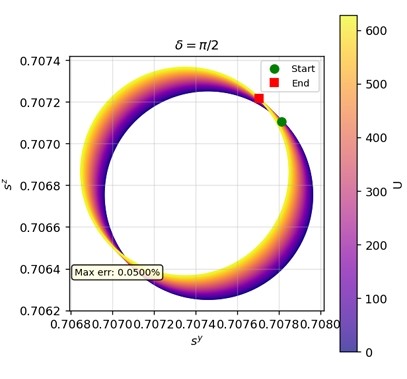
<p>In this note, we aim to show that imposing the Corinaldesi–Papapetrou (CP) spin supplementary condition in Schwarzschild spacetime leads to physically unusual and ultimately inconsistent results.</p>

<p>The CP condition was one of the earliest supplementary conditions introduced in the study of spinning particles in gravitational fields and was employed in the pioneering works of Corinaldesi and Papapetrou.</p>

<p>We demonstrate that this choice predicts an electromagnetic-like spectral structure around a Schwarzschild black hole, while arguing that such a prediction arises from the particular choice of supplementary condition rather than representing a realistic physical phenomenon.</p>

<p>Our analysis highlights the crucial role of selecting an appropriate spin supplementary condition in the study of spin–gravity coupling and the motion of spinning particles, and suggests that the Corinaldesi–Papapetrou condition should be regarded primarily as a mathematical construction rather than a physically consistent description of nature.</p>

<p><a href="/MP/files/Physical Consistency of the Corinaldesi–Papapetrou SSC in Schwarzschild Spacetime.pdf">Physical Inconsistency of the Corinaldesi–Papapetrou SSC in Schwarzschild Spacetime</a></p>]]></content><author><name>Daniel Hakimi</name></author><category term="Quantum" /><category term="Gravity" /><category term="MPD equations" /><category term="Spin-Gravity Coupling" /><summary type="html"><![CDATA[Physical Inconsistency of the Corinaldesi–Papapetrou SSC in Schwarzschild Spacetime In this note, we aim to show that imposing the Corinaldesi–Papapetrou (CP) spin supplementary condition in Schwarzschild spacetime leads to physically unusual and ultimately inconsistent results.]]></summary></entry><entry><title type="html">Applications of MPD</title><link href="https://danielhk2004.github.io/MP/quantum/gravity/Applications-of-MPD/" rel="alternate" type="text/html" title="Applications of MPD" /><published>2025-09-10T00:00:00+00:00</published><updated>2025-09-10T00:00:00+00:00</updated><id>https://danielhk2004.github.io/MP/quantum/gravity/Applications-of-MPD</id><content type="html" xml:base="https://danielhk2004.github.io/MP/quantum/gravity/Applications-of-MPD/"><![CDATA[<p style="color:#1e3a8a !important; font-weight:bold;">
Applications of MPD
</p>
<p align="center">
  <img src="/MP/assets/images/MPD1.png" width="750" />
</p>
<hr />
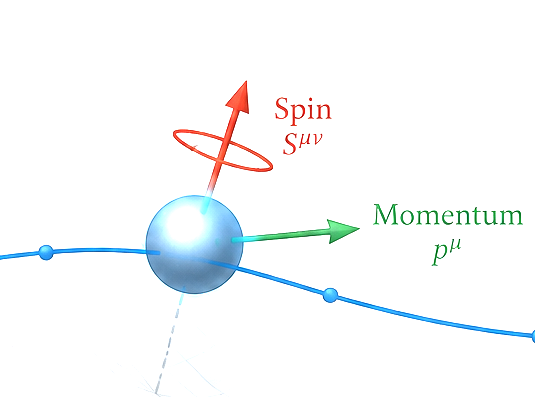
<p>In this note, we aim to derive the MPD equations for the Schwarzschild metric. Then, we examine
 the conservation of several generalized quantities within the MPD system of equations, and finally,
 we study the evolution of the spin vector of a test particle moving in Schwarzschild spacetime.</p>

<p>The theoretical framework developed in this article is based on A. Papapetrou’s seminal paper Spinning Test Particles in General Relativity. In this article, a particular supplementary condition is adopted such that the spin tensor possesses only spatial components. This condition was commonly employed in the early studies of the motion of spinning particles in gravitational fields. However, it does not necessarily lead to physically acceptable solutions in all situations.</p>

<p>Indeed, the choice of supplementary condition plays a crucial role in the analysis of spinning-particle motion in curved spacetime, since an arbitrary supplementary condition does not necessarily yield physically meaningful results. In this note, we adopt one specific supplementary condition and, in subsequent notes, we will demonstrate that it can give rise to several peculiar and physically problematic features.</p>

<p><a href="/MP/files/MPD-AP.pdf">Applications of MPD</a></p>]]></content><author><name>Daniel Hakimi</name></author><category term="Quantum" /><category term="Gravity" /><category term="MPD equations" /><category term="Spin-Gravity Coupling" /><summary type="html"><![CDATA[Applications of MPD In this note, we aim to derive the MPD equations for the Schwarzschild metric. Then, we examine the conservation of several generalized quantities within the MPD system of equations, and finally, we study the evolution of the spin vector of a test particle moving in Schwarzschild spacetime. The theoretical framework developed in this article is based on A. Papapetrou’s seminal paper Spinning Test Particles in General Relativity. In this article, a particular supplementary condition is adopted such that the spin tensor possesses only spatial components. This condition was commonly employed in the early studies of the motion of spinning particles in gravitational fields. However, it does not necessarily lead to physically acceptable solutions in all situations.]]></summary></entry><entry><title type="html">Maxwell’s equations in rotating frame</title><link href="https://danielhk2004.github.io/MP/electromagnetic/Maxwell's-equations-in-rotating-frame/" rel="alternate" type="text/html" title="Maxwell’s equations in rotating frame" /><published>2024-06-25T00:00:00+00:00</published><updated>2024-06-25T00:00:00+00:00</updated><id>https://danielhk2004.github.io/MP/electromagnetic/Maxwell&apos;s-equations-in-rotating-frame</id><content type="html" xml:base="https://danielhk2004.github.io/MP/electromagnetic/Maxwell&apos;s-equations-in-rotating-frame/"><![CDATA[<p style="color:#1e3a8a !important; font-weight:bold;">
Maxwell's equations in rotating frame
</p>
<p align="center">
  <img src="/MP/assets/images/MXL.png" width="750" />
</p>
<hr />
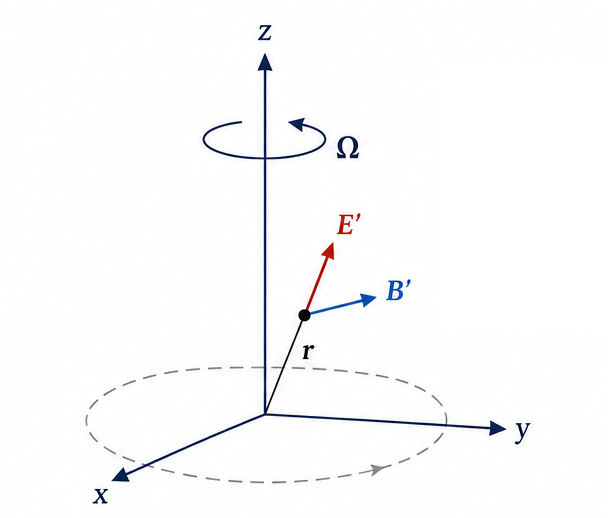
<p>In this note, we have attempted to derive Maxwell’s equations in a rotating frame. This problem holds great significance in electromagnetism and relativity. For instance, this area is highly suitable for the study of nonlocality. The theoretical framework and several key results discussed in this paper are based on the work of Kirk T. McDonald in Electrodynamics of Rotating Systems. As an example, we could relate the final conclusions of this note to theories like GEM or explore frame-dragging from a different perspective.</p>

<p><a href="/MP/files/Electrodynamics%20of%20Rotating%20Bodies.pdf">Maxwell’s equations in rotating frame</a></p>]]></content><author><name>Daniel Hakimi</name></author><category term="Electromagnetic" /><category term="Maxwell&apos;s equations" /><category term="Rotating frame" /><summary type="html"><![CDATA[Maxwell's equations in rotating frame In this note, we have attempted to derive Maxwell’s equations in a rotating frame. This problem holds great significance in electromagnetism and relativity. For instance, this area is highly suitable for the study of nonlocality. The theoretical framework and several key results discussed in this paper are based on the work of Kirk T. McDonald in Electrodynamics of Rotating Systems. As an example, we could relate the final conclusions of this note to theories like GEM or explore frame-dragging from a different perspective.]]></summary></entry></feed>